
Panel Mounted Digital Indicator
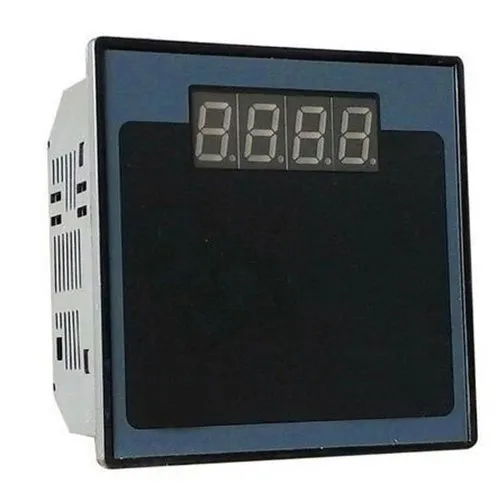
A panel-mounted digital indicator is an industrial instrument that receives analog or pulse signals from sensors and displays the measurement data numerically on a screen. These devices serve as a user interface, providing visual readings of process variables like voltage, current, pressure, temperature, or other sensor data. Key features often include sensor calibration, input signal linearization, alarm outputs, data transmission capabilities for computer or PLC integration, and front-panel controls for easy configuration.
Key Functions and Features
-
Signal Processing:
Converts sensor inputs (e.g., 4-20 mA current loops, voltage signals, pulse signals) into a readable digital format.
-
Digital Display:
Presents the measurement data in a clear, numerical format on a digital screen, often with options for high visibility.
-
Data Operation:
Includes functions like sensor calibration and linearization to adapt to different sensor signals and application requirements.
-
User Interface:
Equipped with front-panel keys for intuitive operation, parameter setting, and menu navigation.
-
Programming Lock:
Offers a lock feature to prevent unauthorized changes to instrument settings.
-
Data Communication:
Can transmit data to computers, PLCs, or other systems for advanced information and control.
-
Min/Max Value Retrieval:
Allows users to view the minimum and maximum values recorded by the indicator.
-
Alarm Outputs:
Can include optional relay outputs to trigger alarms when measured values exceed preset limits.
-
Tare/Offset Functions:
Provides functions to correct zero offsets or tares.
Applications
-
Industrial Automation:
Used in control rooms and instrumentation panels for monitoring processes in various industries, including chemical, water treatment, and food production.
-
Data Collection:
Collects data from sensors and transmitters to increase operating rates and support ISO compliance.
-
System Integration:
Acts as an interface for advanced information systems, allowing for data recording and integration with host computers and controllers.
-
Process Monitoring:
Provides real-time readings for temperature, pressure, flow, and other physical parameters from connected sensors and transducers.